Your morning mail, in five lines
The agentreads what came in overnight and tells you what is urgent and what can wait.
You checkthe one mail it left out, and who else can now read your inbox.
 LearnCaddie
Sign in
Everybody needs to understand what's coming.
Your job runs on knowledge and reasoning. AI now does both, and agents act on their own: they read your mail, sort your files, write in your name. The question isn't whether you'll work with them. It's whether you can tell when they're wrong.
Our courses are being prepared.
Do you need an AI course?
Test yourself in 2 minutes.
Words you hear every day: token, context window, agent, grounding. Can you explain them?
Start the test No sign-up needed.Don't let AI pass you by.
Agents are arriving faster than people are learning to work with them. Research published this year shows the gains are real, and they go to people who know how to use AI and when not to trust it.
higher pay is what job ads offer, on average, when they ask for AI skills. A year earlier it was 57%.
PwC, Global AI Jobs Barometer, Jun 2026a week is what the typical AI user in the euro area reports saving. More than half of people surveyed now use AI for work.
European Central Bank, Consumer Expectations Survey, Aug 2026of business leaders expect AI agents to make important decisions within a year. Only 23% say their people are fully prepared.
Kyndryl, People Readiness Report, Jun 2026of people who use AI at work fear falling behind.
Microsoft, Work Trend Index, May 2026Faster isn't always right.
In a field experiment with 758 consultants, those using GPT-4 finished 12% more tasks and worked 25% faster. On a task just beyond what the AI could do, they got the answer right less often than colleagues without it.
Dell'Acqua et al., Navigating the Jagged Technological Frontier, Organization Science, 2026The gain goes to people who know where AI is strong, where it isn't, and who check the result. That is something you learn.
What the AI age asks of you
Prompt tricks age fast. Principles don't. If you understand how AI works, you can use any tool well, judge what an agent does, and stay in charge of it.
What a model does, why it guesses, what tokens and a context window are, and where its knowledge ends.
Give it the right context, set the rules, pick the right tool, and spot a confident wrong answer.
Know what an agent may do, which tools and data it gets, and where it has to stop and ask.
Set limits, check results, keep a person in charge, and own the decision.
What you learn here: what AI does when you use it at work, how to give it clear instructions, and how to judge what it gives you.
Who are you?
Pick your role. Each one shows three examples. The agent does the work. Whether it got it right is up to you.
Our estimate1–2 hours a weekOur assumption for steady use, not measured. Only if you check what comes back.
The agentreads what came in overnight and tells you what is urgent and what can wait.
You checkthe one mail it left out, and who else can now read your inbox.
The agentsorts your downloads into folders and renames files by date and topic.
You checkwhat it may move or delete, and that nothing private lands in the cloud.
The agentcompares three offers for a trip, a phone plan or a repair.
You checkthe prices against the source, and what the comparison leaves out.
Our estimate2–3 hours a weekOur assumption for steady use, not measured. Only if you check what comes back.
The agentdrafts one page from the numbers, the mails and the meeting notes.
You checkwhere every number comes from.
The agentlays out the options with pros and cons.
You checkwhat it assumed, and whose view is missing.
The agentflags the clauses that look unusual.
You checkthat it read the whole contract. In a long chat, the start drops out of view.
Our estimate2–4 hours a weekOur assumption for steady use, not measured. Only if you check what comes back.
The agentturns the meeting transcript into decisions, tasks, owners and dates.
You checkthat owners and dates match what was really said.
The agentwrites the weekly status from the tickets.
You checkthat red stays red.
The agentreminds the owners of open risks every week.
You checkwhat it is allowed to send in your name.
Our estimate2–5 hours a weekOur assumption for steady use, not measured. Only if you check what comes back.
The agentwrites a post, a mail and an ad in three variants each.
You checkevery claim against what you can prove.
The agentsums up what changed on five competitor sites this week.
You checkthe sources and the dates.
The agentplans a month of topics from your goals.
You checkthat it fits what your product really does.
Our estimate2–4 hours a weekOur assumption for steady use, not measured. Only if you check what comes back.
The agentputs the customer on one page from your CRM and public sources.
You checkfacts that are old or simply wrong.
The agentdrafts the mail after the call.
You checkpromises you never made.
The agentupdates the record with what was agreed.
You checkwhat it writes into records others rely on.
Our estimate2–5 hours a weekOur assumption for steady use, not measured. Only if you check what comes back.
The agentanswers a request from your knowledge base.
You checkthat the answer matches today's policy.
The agentsorts incoming tickets by urgency.
You checkthat the angry customer isn't at the bottom.
The agentturns the questions you get most into an FAQ.
You checkthat no customer data ends up in it.
Our estimate2–4 hours a weekOur assumption for steady use, not measured. Only if you check what comes back.
The agentreads receipts and invoices into one list.
You checkamounts, dates and duplicates.
The agentfinds a slot across five calendars and sends the invites.
You checkwhat goes out in your name.
The agentchecks forms for missing or odd fields.
You checkthe rules it doesn't know.
Our estimate2–3 hours a weekOur assumption for steady use, not measured. Only if you check what comes back.
The agentmatches incoming payments to open invoices.
You checkthe matches it guessed.
The agentruns the month-end checklist and chases what is open.
You checkevery step it marks as done.
The agentexplains in plain words why costs moved.
You checkits numbers against the ledger.
Our estimate2–3 hours a weekOur assumption for steady use, not measured. Only if you check what comes back.
The agentdrafts the ad from the role description.
You checkfair wording, and promises you can keep.
The agentplans the first week for a new colleague.
You checkthat it fits your policies and your team.
The agentanswers questions from the employee handbook.
You checkthat it uses the current version, and that sensitive questions go to a person.
Our estimate2–3 hours a weekOur assumption for steady use, not measured. Only if you check what comes back.
The agentcompares offers on price, delivery and terms.
You checkwhat hides in the small print.
The agenttracks open orders and writes to late suppliers.
You checkwhat it may send to suppliers.
The agentsums up the terms that matter.
You checkthat nothing important was left out.
These are examples. Learning what an agent does, and judging what it gives back, is what the courses are for. In LearnCaddie you judge cases with Your Caddie. The hours per role are our assumption. For comparison: the typical AI user in the euro area reports saving 3 hours a week (European Central Bank, Aug 2026).
A learning path, in preparation
A path for people who use AI at work: from understanding what AI can and cannot do, to giving it clear instructions, to designing and steering AI agents. Along the way, you judge cases from everyday work yourself. Your Caddie teaches you as you go.
Membership: $20 a month. Cancel anytime.
Reading about AI isn't learning it.
Not a chat. Not a course.
A private AI tutor who stays.
Your Caddie knows where you stand, asks before it tells, checks what you've really understood, and brings it back until it's yours.
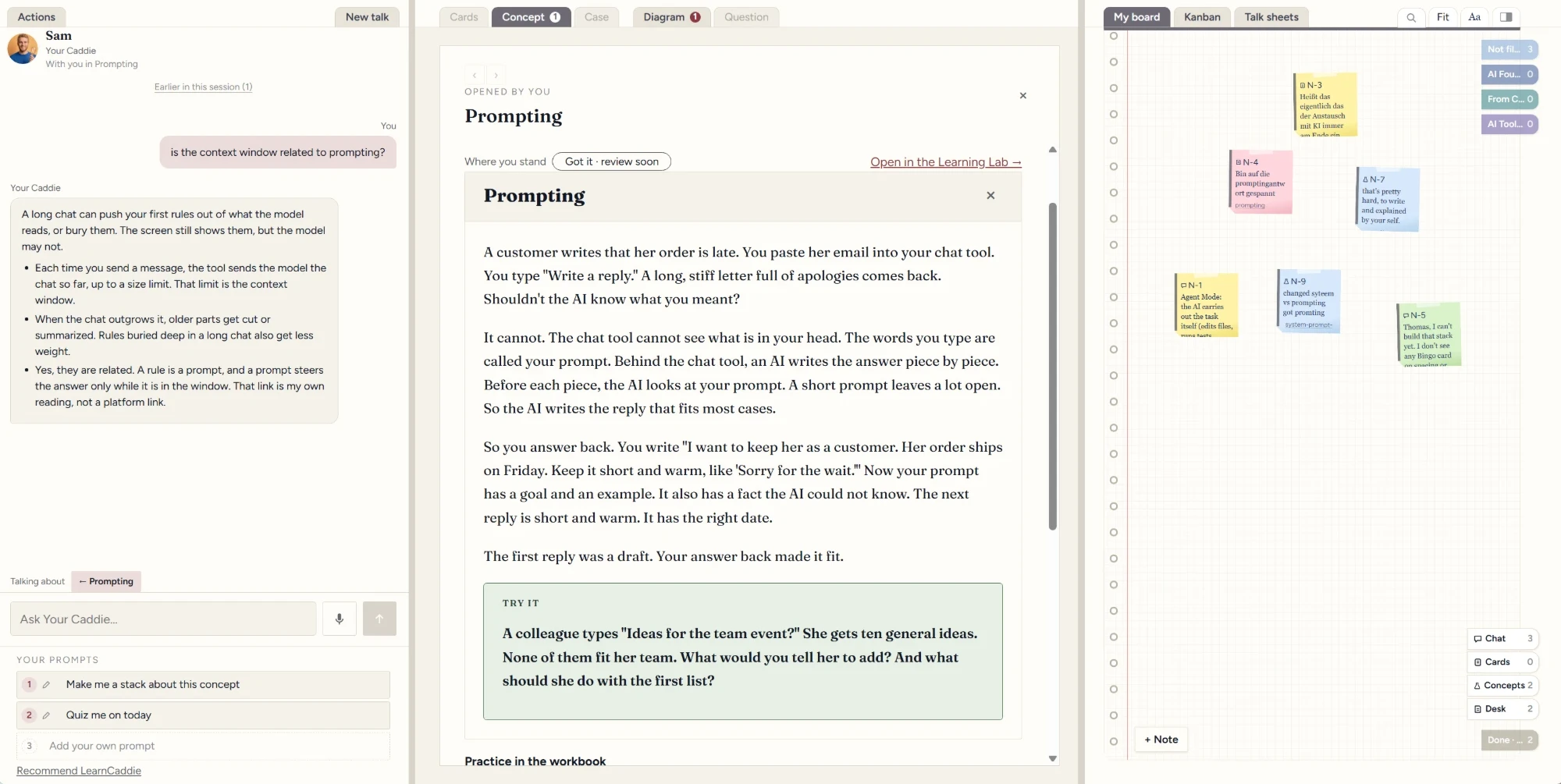
Test yourself · five words from AI at Work, 2 minutes, no sign-up
This test needs JavaScript, which seems to be switched off here.
1 Pick a word that sounds familiar.
2 Choose the question you think you can answer.